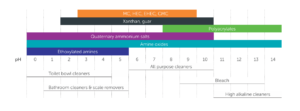
Amine-based surfactant thickeners, are more effective across the whole pH range, also they support formulation stability in presence of chlorine and hydrogen peroxide bleach.
Amine-based surfactant thickeners include amine oxides, ethoxylated amines and quaternary ammonium surfactants.
Contact time of thickened detergent with surfaces (specially inclined or vertical surfaces like toilet bowls and tiled walls) is more than ordinary products, so the longer adherence results in an improved removal of soil, limescale and microorganisms as well as extended perfume release for better air-freshening.
Also, the higher viscosity of these products allows for an improved control of dosage and increases the safety of consumers by avoiding splashes and leaking.
The function of amine-based surfactants as thickening agents is the model of rod micelle formation. Viscosity increase is due to entanglement of the rod-like micelles which spontaneously form in solution with these surfactant products. The viscosity level that can be achieved gets higher as the alkyl chain length of the surfactant hydrophobe gets longer.
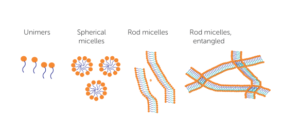
Small amounts of additives like SXS, SCS, soaps and ethoxylated alcohols can decrease the amount of amine-based surfactant needed to achieve the desired viscosity level.
Natural polymers (xanthan gum, guar gum) are not stable at extreme pHs. Synthetic polymers such as polyacrylates are less stable in strong acidic conditions. In comparison, amine-based surfactant thickeners not only are very stable across the whole pH range, but also contribute to cleaning, foaming, solubilization and stability of the formula.