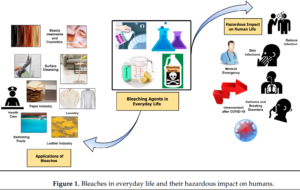
Bleaching agents have been integral constituents of cleansing systems for more than a century in laundry detergents, surface cleaners, dishwashing powder, cosmetics, wastewater treatments, disinfecting agents, and many more. Bleaching agents are materials that lighten or whiten a substrate through a chemical reaction. Bleaching usually involves either oxidative or reductive reactions that decompose stains and soils. These processes may involve the removal or change of larger molecules and color-bearing groups in the stain or soil into smaller, more soluble units which are more easily removed in the bleaching process. Figure 1 depicts bleaches in everyday life and the hazards they pose to humans.
As per their composition, bleaching agents fall into several categories, such as optical brighteners, chlorination agents, peroxides or peracids, fluorescent whitening agents, ozone, quinones, etc.
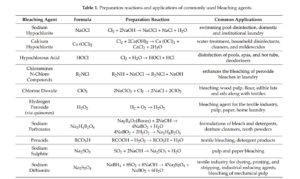
Table 1 presents some common bleaching agents that are used daily
Bleaching Agents in the Laundry Industry
Bleaching agents are key components of laundry techniques. Current industrial laundry techniques reduce microorganisms and achieve cleanliness through physical, chemical, and thermal processes, producing hygienically clean healthcare textiles. Dispersion techniques are used to enhance the distribution of bleaches or optical brighteners in detergent powders compared to direct pouring into the agglomeration (mixing) vessel, thus boosting their whitening ability. A brightener on the surface of a detergent powder shows a greater whitening impact than if incorporated inside the granules, enhancing the cleansing process.
The pursuit of efficient energy management in the laundry industry has steadily reduced washing temperatures and harmed antimicrobial performance; temperature plays a vital role in the cleansing process. Unless bleach is added, effective cleaning against all microorganisms is not guaranteed at temperatures under 60 ◦C. It has been proven that the use of bleaching agents in the form of active oxygen bleach (AOB) containing detergents inactivates most germs effectively, even at low temperatures. Along with temperature, the pH of the bleaching system, concentration bleach and contact duration are also vital for the cleansing process in laundry.
Table 2 displays the bleaching conditions suitable for different fabrics

Besides brightness, microbial disinfection is an essential role of bleaches in the laundry industry. Figure 2 portrays the various roles of bleaches in laundering.
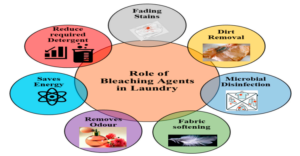
Figure 2. Role of bleaching agents in laundry
Sources:
https://www.aboutcleaningproducts.com/science/details-of-bleaches/
Bleaching Agents: A Review of Their Utilization and Management