The skin is a vital organ with two main roles. It is a barrier that prevents internal water evaporation and aggressions from the external environment. It is also a sensory organ that is at the interface between the internal and external worlds. The skin barrier has several exceptional functions. The stratum corneum (SC) is composed of two main components, namely corneocytes (non-nucleated dermal keratinocytes) and intercellular lipids. The architecture of the stratum corneum resembles a “brick and mortar” model, ensuring a very thin and flexible yet highly efficient physical barrier. Intercellular lipids are mainly composed of three lipid classes, cholesterol, free fatty acids (FFA), and ceramides, with an approximate molar ratio of 1/1/1. Decades of research have led to the identification of SC ceramides and an understanding of their arrangement. If the critical architecture of the SC lipid matrix is disrupted in its composition, the barrier function is compromised, and along with other pathophysiological processes, it causes various levels of skin disorders. Given the importance of ceramides, this article focuses on the structure and role of ceramides in intercellular lipids, their potential benefits in skin care, and the challenges associated with their formulation in products for topical applications.
Ceramide Biology
- Ceramide Structure
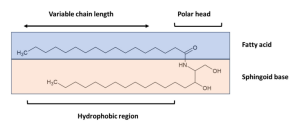
Ceramides are a family of lipids characterized by the connection of a sphenoid base and a fatty acid via an amide bond. The fatty acid carbon chain varies in length and is mostly saturated. Ceramides are amphipathic molecules with hydrophilic and hydrophobic regions. The hydrophilic region is mainly formed by the hydroxyl groups on the sphenoid base and the amide bond, and the hydrophobic region is formed by the two carbon chains of the sphenoid base and the fatty acid. This amphipathic nature is important for the formation of the lamellar structures found in the intercellular cement of the stratum corneum (Figure 1).
- Ceramide Classification
Ceramides are grouped into several categories based on their molecular structure. Ceramide categories are identified by a combination of letters, with the first letter describing the type of fatty acid and the second letter describing the type of spongy base. This classification can be further refined by providing the number of carbons and the degree of unsaturation of the fatty acid chain to describe an individual ceramide. The most common components of skin ceramides, for the fatty acid part are:
non-hydroxy (N), α-hydroxy (A), ester-linked ω-hydroxy acid (EO) and to a lesser extent ω-hydroxy (O) fatty acids
and for the sphingoid base:
phytosphingosine (P), sphingosine (S), 6-hydroxy-sphingosine (H), dihydrosphingosine (dS) and at a lower level 4, 14-sphingadiene (SD)
Ceramide NP: a non-hydroxy acyl chain linked to a phytosphingosine
Ceramide AS: an α-hydroxy acyl chain linked to a sphingosine base
Ceramide EOH: a linolenic chain esterified to an ω-hydroxy acyl chain linked to a 6-hydroxy sphingosine
Ceramide biosynthesis
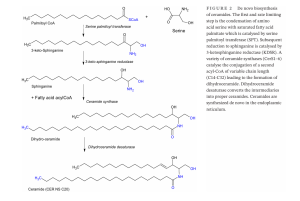
Ceramide production can occur via different pathways: hydrolysis of complex sphingolipids (e.g. sphingomyelin) or glucosylceramides and de novo synthesis from the basic building blocks, which involves a series of enzymatic reactions in cells. The latter process usually occurs in the endoplasmic reticulum with the following main steps:
– Condensation of the two basic building blocks, serine and palmitoyl-CoA, by the enzyme serine palmitoyl-transferase (SPT) to form 3-keto-dihydro-sphinganine
– Reduction of the ketone by keto-dihydro-sphinganine reductase (KDHR) to produce dihydro-sphingosine.
– Condensation of dihydro-sphingosine with a fatty acid activated by acetyl-CoA to form dihydroceramide. This step is catalyzed by a group of six enzymes called ceramide synthases (CerS) 1-6, which have different affinities for different types of fatty acids and therefore produce different dihydroceramides.
– Modification of dihydroceramides by dihydroceramide desaturation. These enzymes introduce a double bond into dihydroceramide, converting it to ceramide. A summary of the de novo biosynthesis of ceramides is outlined in Figure 2.
Ceramides are then transported from the endoplasmic reticulum to the Golgi apparatus and can undergo additional modifications such as glycosylation (addition of sugar groups) and sulfation (addition of sulfate groups). These processes lead to the formation of complex sphingolipids, including sphingomyelin and glycosphingolipids.
The structural diversity of ceramides results from the diversity of sphingoid bases and fatty acids used during synthesis and from the differential expression of ceramide synthases. Different types of ceramides can be distinguished based on the length of the fatty acid chain, with ceramides being long chain (LC) (C14-C18), very long chain (VLC) (C20-26), and ultra-long chain (ULC) (>C26). In the human stratum corneum, the fatty acid length varies from C18 to C36, with most ceramides having a C24-C28 fatty acid moiety.
Composition of Ceramides in the Stratum Corneum
The ceramide composition of the lipid matrix of the normal (healthy) stratum corneum in humans is predominantly of the non-hydroxy family (NP), NH, NS and NDS, which account for about 55% of the total free ceramides, followed by alpha-hydroxyceramides (AH), AP and AS, which account for about 35% of the total unbound ceramides. At a lower level, ω-esterified ceramides (EOS), EOH and EOP) account for about 10% of the total ceramide mass.
Ceramides and skin barrier function
Ceramides, along with cholesterol and free fatty acids, are the main components of intercorneal lipids and play an important role in skin barrier function, preventing internal water evaporation and the penetration of external aggressors. The effectiveness of lipids in forming an efficient barrier is closely related to their composition, structure, and relative arrangement, and all parameters are interrelated. Looking at the overall organization of the stratum corneum (SC), stratum corneum lipids are located between corneocytes and fill the space that separates the cells. Electron microscope images of this space between corneocytes show that the lipids are organized in a sequence of regular blades that are approximately parallel to the corneocyte and skin surface. It has also been shown that there is a specific layer covering the corneocyte surface, called the corneocyte lipid envelope (CLE), which forms the interface between the hydrophilic surface of corneocytes and the intercorneocyte lipids.
The relative amount of ceramide, the distribution of ceramide classes and the acyl chain length are related to the quality of barrier function in lipid models. Given the importance of the barrier formed by SC in skin physiology, potential changes in the level and arrangement of intercorneocyte lipids are normal in the skin, especially when the skin is exposed to various external or internal stressors such as cold, UV light, aging or during chronic inflammatory skin diseases such as atopic dermatitis and psoriasis.
The amount and type of ceramides are influenced by factors such as seasonal changes, aging and skin diseases such as atopic dermatitis (AD), psoriasis.
Potential Use of Ceramides in Skin Care Products and Challenges of Ceramide Formulation
A change in the composition of ceramides is associated with defects in the skin barrier. Regardless of the origin of the disorder, healthy skin should be able to initiate repair processes and repair the damage by synthesizing the appropriate lipids. However, for underlying genetic or environmental reasons, sometimes skin diseases stop lipid regeneration and the required rapid repair is not achieved. For this reason, the use of moisturizing lotions in combination with anti-inflammatory therapy to manage the damaged skin barrier exists.
The development of skin care products containing ceramides requires the solubilization and dispersion of ceramides in a form that is deliverable and acceptable to the skin. When formulating such compositions, formulators face the challenge of solubilizing ceramides.
Ceramides need high temperature (above 80°C) to be solubilized in well- chosen oils, emulsifiers and thickeners to avoid recrystallization during the cooling process.
This limits the number of formulation chassis that can incorporate such a hot premix without destabilizing the emulsion. However, there are various types of emulsions to deliver ceramides to the subcutaneous layer (SC) using conventional emulsions, containing microparticles, nanoparticles or liposomes, and using penetration enhancers.
For more study: The role of ceramides in skin barrier function and the importance of their correct formulation for skincare applications