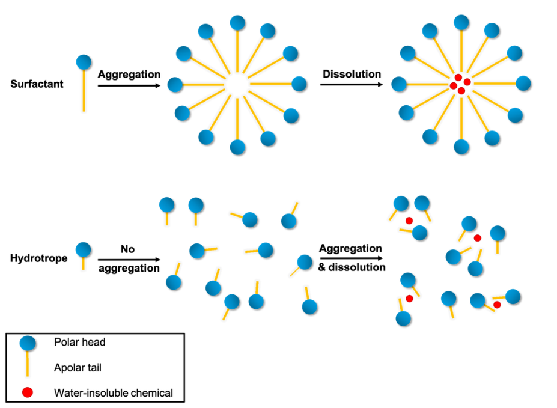
Hydrotropes have both a hydrophilic (water-loving) and a hydrophobic (water-repelling) part in their structure that enhance the solubility of otherwise poorly soluble ingredients in water. They do this by making water more effective at dissolving hydrophobic compounds, a process that is different from micellar solubilization. Essentially, hydrotropes act as “solubilizers,” helping to create stable and uniform formulas. Also, they improve spreadability of formula on the skin and increase cleansing efficiency by enhancing the ability of water to dissolve dirt and oil.
Common hydrotropes include urea, tosylate, cumenesulfonate, and xylenesulfonate.
Hydrotropes can simplify formulation, reduce the need for complex emulsifiers, and even help improve the effectiveness of certain active ingredients.