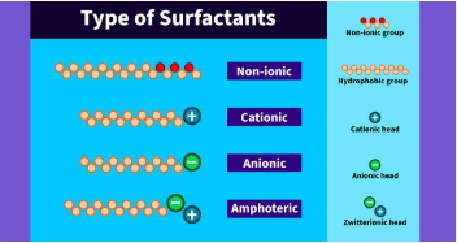
In detergent, a surfactant is the key ingredient responsible for cleaning. It’s a “surface active agent” with a dual nature: a water-loving (hydrophilic) head and a water-hating (hydrophobic) tail. The hydrophobic tail attaches to dirt and grease, while the hydrophilic head interacts with water, allowing the surfactant to form a micelle that traps the soil and pulls it away from the surface to be washed away in the solution.
The hydrophilic head of each surfactant is electrically charged. The charge can be negative, positive, or neutral. Depending on the charge of the hydrophilic head, the surfactant is classified as anionic, nonionic, cationic or amphoteric.
Showing 1–16 of 20 results
-
Airipon (INCI: sodium lauryl ether sulfate)
Read more -
Cetrimonium chloride
Read more -
COCAMIDOPROPYL BETAINE
Read more -
DIHYDROGENATED TALLOWAMIDOETHYL HYDROXYETHYLMONIUM METHOSULFATE
Read more -
Dihydrogenated tallowamidoethyl hydroxyethylmonium methosulfate
Read more -
LAUCOSOL L
Read more -
LAURETH-7
Read more -
LAURETH-9
Read more -
Lauryl Glucoside
Read more -
Lauryl PEG-8 Dimethicone
Read more -
Oleic acid
Read more -
Oleyl Amine Ethoxylate Ether(2EO)
Read more -
PEG-75 LANOLIN
Read more -
PEG-80 SORBITAN LAURATE
Read more -
SODIUM CUMENESULFONATE
Read more -
SODIUM DODECYLBENZENESULFONATE
Read more
