There are various methods to prove claims made in cosmetic products, here are some of them:
1- Evaporimetry (TEWAmeter)
Evaporimetry is used to measure the moisturising effect of a cosmetic product. It uses a probe with moisture detectors, that when placed against the skin’s surface, measures the difference in the moisture content between the two detectors, and thereby gives a measure of TEWL.

The TEWL of the skin is measured before and after cosmetic product is applied, indicating the content of moisture within the skin before and after the application of a moisturiser.
2- Flexometry (cutometer)
The cutometer is used to measure the elasticity of the stratum corneum. It uses a suction probe applied to the skin, which then pulls the skin and relaxes it, measuring the level of deformation that occurs, as well as the time taken for the skin to return to normal.
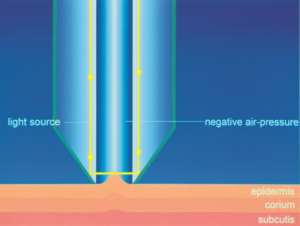
Measurements of the skin’s response are taken before and after cosmetic product is applied. Since moisturisers’ increase the elasticity response of the skin, readings taken after the application of a cosmetic product measure how much elasticity of the skin has increased by (that is, how much further it can deform and how much quicker it returns to normal).
3- Skin hydration (corneometer)
Hydrated skin reflects a well-functioning skin barrier. Only an intact NMF (natural moisturizing factor) provides an effective scavenging function against radicals and nitrogen oxides penetrating from the outside, and consequently protects the skin against premature skin aging.
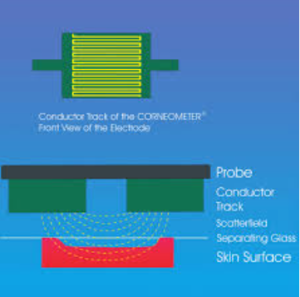
A corneometer measures the moisture retention capacity of the skin based on the dielectric constant of the water in the superficial layers of the stratum corneum up to 10-20 µm.
4- Measuring sebum content of skin (sebumeter)
A sebumeter measures the sebum/oil content on the surface of the skin. The measurement is taken with a parchment like foil which becomes transparent after contact with lipid substances.
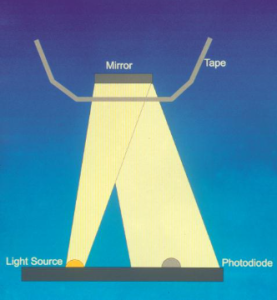
The foil is pressed on the skin for a few seconds, and the change in transparency is measured with the help of a source of light (photometric method), making it insensitive to humidity.
5- Measuring skin tone (mexameter)
A mexameter is used to measure melanin and/or redness of skin. A tool is placed on to the skin and measures the melanin and erythema of the skin, based on a source of light with three specific wavelengths whose radiation is absorbed by the skin and diffusely reflected.
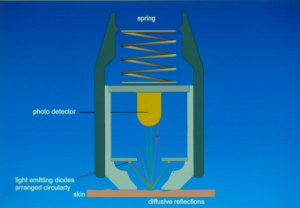
The measuring probe is used to quantify the skin redness (erythema) and determine the degree of skin tanning (melanin) or whiteness. The probe can also measure the irritant effects of cosmetic formulas as well as soothing effects of active ingredients.
6- Measuring wrinkle depth (skin visiometer)
The skin visiometer is a device with a parallel light source and a black and white CMOS-camera with 640 * 480 pixels.
A skin replica is taken by applying a thin sheet of specialized silicone on the skin, and then removing. This provides a replica of the contours of the skin, which is then placed between the light source and a camera. The light absorption of the blue color is known. When the light penetrates the replica, it is absorbed according to the thickness of the silicone material.
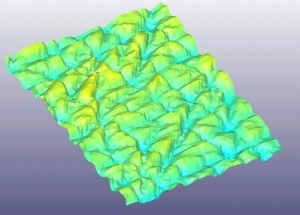
The replica reproduces the heights and depths of the skin as a negative, i.e. wrinkles are higher in the replica as the silicone is thicker in this place.
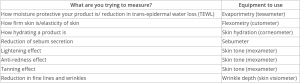
Here is a table summarizing the equipment we’ve just looked at.