Amino acids are the building blocks that form polypeptides and ultimately proteins. Consequently, they are fundamental components of our bodies and vital for physiological functions such as protein synthesis, tissue repair and nutrient absorption.
Essential amino acids in alphabetical order:
Alanine (Ala), Arginine (Arg), Asparagine (Asn), Aspartic acid (Asp), Cysteine (Cys), Glutamine (Gln), Glutamic acid (Glu), Glycine (Gly), Histidine (His), Isoleucine (Ile), Leucine (Leu), Lysine (Lys), Methionine (Met), Phenylalanine (Phe), Proline (Pro), Serine (Ser), Threonine (Thr), Tryptophan (Trp), Tyrosine (Tyr), Valine (Val)
The basic structure of an amino acid is:
H2N-CR-COOH
There are 20 amino acids that make up proteins and all have the same basic structure, differing only in the R-group or side chain they have.
Amino acids are in an equilibrium between two acids with the proton (H+) moving between the amino group and the carboxyl group as shown below:

In such an equilibrium, the weaker acid always predominates. As ammonia is a weaker acid than carboxylic acid, the equilibrium will lie to the left (on the “zwitterion” side). Although amino acids are often shown in textbooks as the right-hand structure, they actually mostly exist as the left-hand structure.
The simplest, and smallest, amino acid is glycine for which the R-group is a hydrogen (H). They can be subdivided according to their properties, dictated by the functional groups they possess. Broadly they are divided by charge, hydrophobicity and polarity. These properties influence the way they interact with surrounding amino acids in polypeptides and proteins, and consequently impact protein 3D structure and properties.
What is the structure of the amino acids?
An amino acid’s structure consists of a central carbon atom attached to a hydrogen, an acidic carboxyl group (−COOH), an amino group (−NH2) and an organic side chain (also called an R group). The side chain is unique in each of the 20 amino acids.
The chemical structures of the 20 amino acids that make up proteins, are:
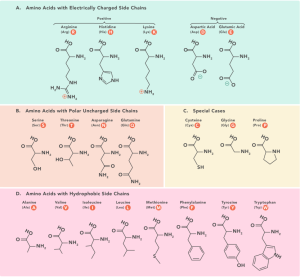
Smallest Amino Acid is Glycine (Gly) with ~75 Da molecular weight and largest Amino Acid is Tryptophan (Trp) with ~204 Da molecular weight.
To form a protein, amino acids are polymerized with the formation of a peptide bond, starting at the N-terminus and ending at the C-terminus.
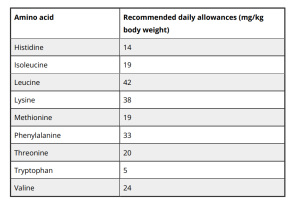
The human body is able to synthesize 11 of the 20 amino acids. The nine amino acids that human body can’t synthesize are: histidine, isoleucine, leucine, lysine, methionine, phenylalanine, threonine, tryptophan, and valine and we need to them through dietary intake.
Foods that contain all nine essential amino acids are referred to as “complete proteins”, and include meat, seafood, eggs, dairy products, soy, quinoa and buckwheat. Other protein sources, such as nuts, seeds, grains and beans, contain some but not all essential amino acids and are therefore referred to as incomplete.
The United States recommended daily allowances per 1 kg of body weight for the nine essential amino acids.