The Greenhouse Gas Protocol – which provides the most widely recognised accounting standards for greenhouse gas emissions – categorises GHG emissions into three ‘scopes’.
Scope 1 covers direct emissions from owned or controlled sources. Scope 2 covers indirect emissions from the purchase and use of electricity, steam, heating and cooling. By using the energy, an organisation is indirectly responsible for the release of these GHG emissions. Scope 3 includes all other indirect emissions that occur in the upstream and downstream activities of an organisation.
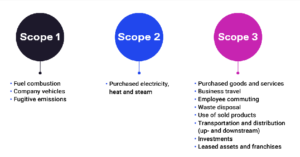
Evonik’s Active Oxygens business line is enabling customers to lower their Scope 3 emissions.
Peracetic acid, or PAA, is a versatile broadband disinfectant used in a wide variety of applications. It is comprised mainly of hydrogen peroxide (H2O2) and acetic acid, a natural substance that provides the tart component in vinegar. After use, PAA breaks down into only water, oxygen, and acetic acid – leaving little chemical trace on the environment. According to Evonik, it is now complementing this positive “handprint” with a lower environmental “footprint”: By using inputs from renewable resources, it can produce its PAA with lower emissions compared to conventional means.
Evonik says: Active Oxygens is already progressing along our roadmap toward net zero emissions by 2040. But customers don’t have to wait until 2040 to benefit. By applying a mass balance approach to identify the portion of our PAA that already has a low carbon footprint (LCF), we can issue an ‘LCF pass’ for this product. The pass enables customers to transparently reduce their Scope 3 emissions – with no change in quality, performance, or even the regulatory framework, such as biocidal approval.
The mass balance approach involves calculating a product’s carbon footprint by measuring the proportion of sustainable inputs, such as raw materials and energy. For this calculation, Evonik follows the established norm ISO 22095-2:2026 and TfS guideline 2024. The low carbon footprint for Evonik’s PAA is achieved using bio-based acetic acid as a raw material together with Evonik’s LCF hydrogen peroxide.
Evonik’s low carbon footprint PAA is available immediately for all PAA brands within the portfolio.