Alginate is a kind of natural polysaccharide consisted in brown seaweed, as a natural product generated from alginic acid indwell in seaweed and minerals indwell in sea. Alginic acid is a mix-polysaccharide composed of D-mannuronic acid(M) L-guluronic acid(G). The main alginate series include sodium alginate, potassium alginate, calcium alginate, ammonium alginate etc.
Chemical structure of Alginate is:
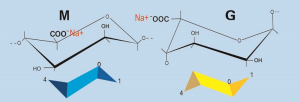
Benefits of sodium alginate in cosmetics are:
- Enhancing Texture and Consistency
It acts as a thickening agent, providing a smooth and luxurious feel to creams, lotions, and gels. This property ensures that products are easy to apply and distribute evenly on the skin, enhancing the overall user experience.
- Emulsifying Properties
Sodium alginate serves as an excellent emulsifier. It helps blend oil and water-based ingredients, ensuring a stable and uniform product. This is particularly beneficial in formulations such as moisturizers, serums, and sunscreens, where a consistent mixture is essential for effectiveness and stability.
- Moisturizing and Hydrating
Sodium alginate also functions as a hydrating agent because of its water-binding properties. By forming a protective barrier, sodium alginate helps to lock in moisture, keeping the skin soft and supple. This is especially useful in face masks, eye creams, and hydrating lotions.
- Stabilizing Formulations
One of the key benefits of sodium alginate in cosmetics is its ability to stabilize formulations. It prevents ingredients from separating, ensuring that the product remains consistent throughout its shelf life.
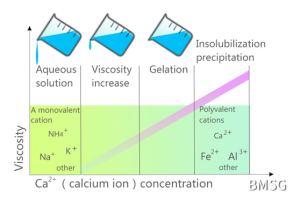
- Film and gel-forming next to Ca ions
Sodium alginate reacts with calcium ions to form a gel quickly, and this gel is not reversible. Alginate gels with high G concentrations are brittle but very stiff, while alginate gels with high M concentrations are the opposite, flexible but less stiff. Different gel strengths are made with different ratios. With different gels, alginate can be used for different applications such as face masks, etc.
Sodium alginate is used in a variety of cosmetic products, including:
Face Creams and Lotions: For improved texture and hydration.
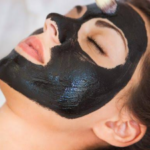
Face Masks: To provide a hydrating and skin-softening effect.
Serums: As an emulsifier for a smooth, consistent product.
Sunscreens: For stabilization and even application.
Shampoos and Conditioners: To thicken and stabilize formulations.
Body Washes: For a luxurious, consistent texture.
Eye Creams: To retain moisture and reduce the appearance of fine lines.